Thank you for purchasing the Zoe Wisdom Journal. Utilizing the journal in your day-to-day life will guarantee constant lasting improvement in your lives. However, we understand that navigating this journal might not be easy. And so this small guide was created to help you understand the journal’s framework.
First, let’s take a look at what a Zoe Wisdom Journal page looked like.
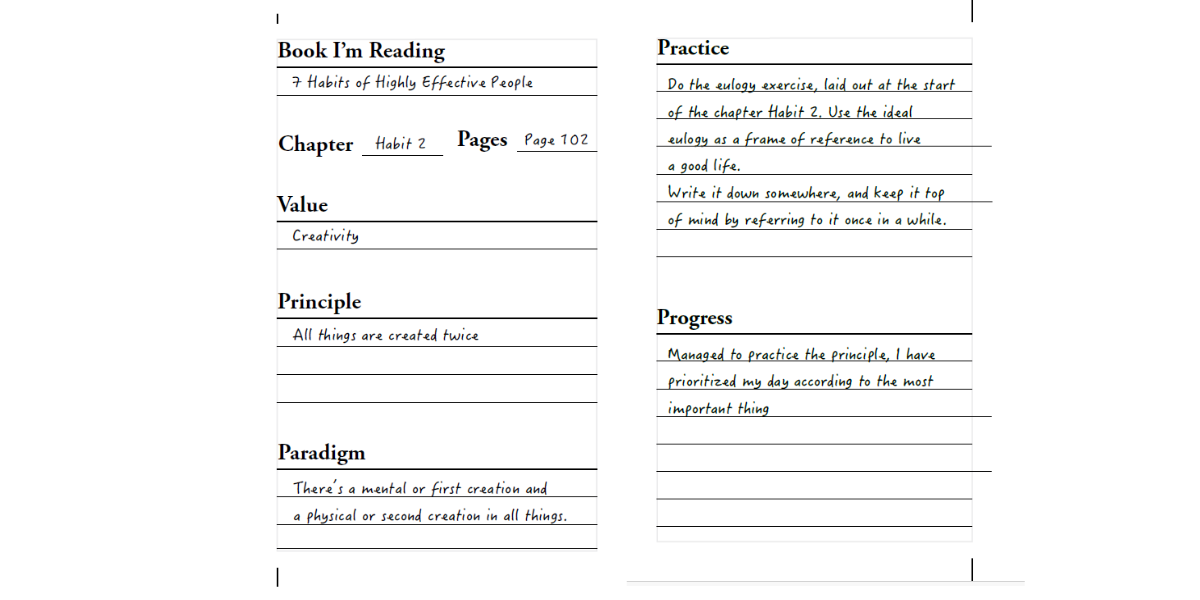
Although there is no fixed instruction on how you should use the journal, here is how we suggest you use Zoe Wisdom journal in three simple steps:
- Examine
- Encrypt
- Engage
Let’s break them down one by one.
1. Examine
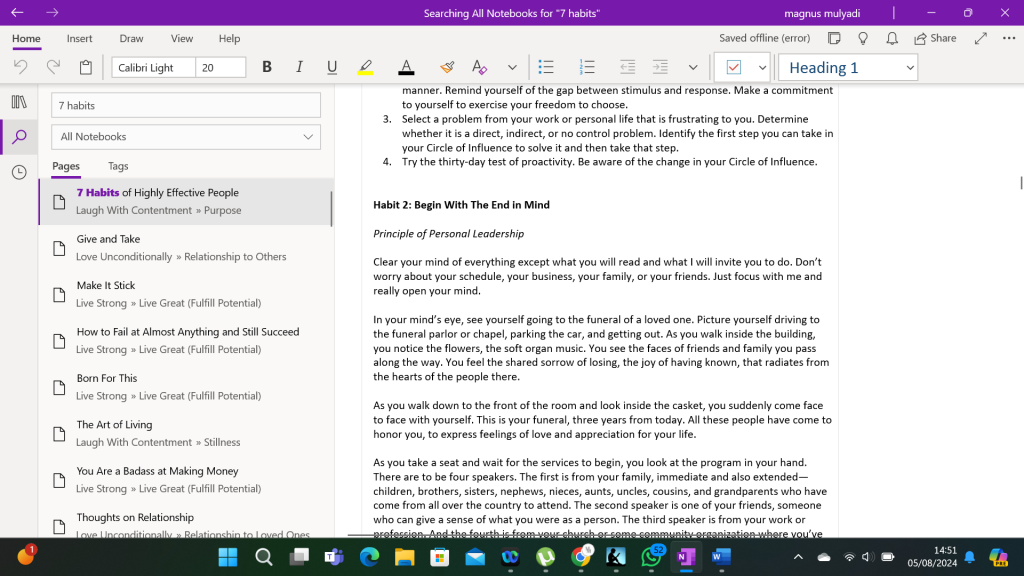
Whether you are reading a book, attending a seminar, or joining a webinar; what you want to have in the beginning is a summary note of the book/seminar/ webinar you are engaging in. Ensure that you have a summary of the information you are trying to learn in a concise and accessible format during the whole encryption session.
For me, my summary notes usually come from self-help books and it contains the main point of the chapter, interesting anecdotes, useful paradigms, and examples of how we could apply the idea in our day-to-day life. Here is an example from my Microsoft OneNote notes:
2. Encryption
Now with your notes ready, let’s sort that information into principles, paradigms, practices, and the information’s values. Here’s a brief description of each
Principles
Principles are the operant laws of the universe. Ignore them and we will hurt ourselves or miss achieving our goals. Even if by luck we manage to attain success without obeying these ‘natural laws’ success will be temporary. For millennia, wise men from Plato to Stephen R. Covey have tried to capture these principles into statements, but these statements are usually mere approximations of the principle, not the whole principle itself. An example of a famous self-help principle is: All things are created twice, taken from the book 7 Habits of Highly Effective People by Stephen R. Covey.
A good question to gauge if information is a principle is: “Is this statement inherently true in all situations? If the answer is yes, then it is a principle.
Paradigm
A paradigm is a way of seeing the world that expresses a person’s core values and beliefs. Because all values and beliefs are subjective and may not be based on the right principle, you should never consider them as truths. Unlike principles, which are constant and true for everyone, paradigms are subjective, what may be true for one is not true for others. An example of a famous paradigm often mistaken as a principle is the idea that “whatever consumes your thought is what you will eventually get in life.” Yes to some degree, having a positive thought is a good thing, but without a positive action to follow it up; that thought will just become a thought.
Or consider the paradigm from the 7 Habits of Highly Effective People. The reason why ‘there’s a mental first creation and a physical or second creation in all things’ is a paradigm is because in the dawn of AI age, it might not always be the case. Paradigm at its essence stems from a person’s beliefs and point of views, they are not based on facts.
Paradigms usually starts with I believe… And unlike Principles, if the answer to the question, ‘Is this statement inherently true in all situations?’ is no, then it is probably a paradigm.
Practice
Practice is the attempt to translate information into practical actionable steps to improve our lives. It is usually the part in the self help book where the author encourages you to take out a pen and paper; and start writing down things. Practicing things are the only way to make real changes in life, but ensure that whatever practices you are doing, they are based on the right principle. For example, the exercise to visualize and writing down our eulogy is a great practice to clarify our values and purpose in life. Other practices like ‘never put too much trust in Friends. Learn how to use enemies’ from the 48 Laws of Power might not be practicable in all situations.
A practice can usually be identified by its action-orientedness. When an author asks you to take out a pen and a paper or to start some habits, it is probably a practice.
Values
Values can mean many things, but in our context, values are the meanings we attach to certain objects or information. Of course, as meaning is subjective the same information can offer different meanings to different people, and as a result, can offer different values to different people.
The reason we want you to consider what values certain wisdom offers is because we know that there is too much wisdom to accumulate in the world and as a human being with a very limited time on Earth, it is impossible to acquire them all.
Hence what you want to do is to focus and familiarize yourself with wisdom that actually affirms your values in life or at least, affirms the values of your ideal selves. When wisdom is not relevant to you or the future you, feel free to skip it.
have two meanings. Internally, values are the measuring stick by which we determine what is a successful and meaningful life. They are internal, subjective, and malleable. By valuing the right principle, you will live a good life.
For example, let’s look at Stephen R. Covey’s famous principle from the 7 Habits of Highly Effective People book, “All things are created twice.” I would then ask myself: what value does this principle/paradigm affirm? And the word creativity comes up in my mind. And that is the value I attach this information because this principle supports my creativity values.
The best time to do encryption in my opinion is to do it in the early morning. Ensure that you are not distracted and take 10-15 minutes to encrypt the information into the respective format.
3. Engage
Now after you have encrypted the crucial information, what you want to do is to refer to it throughout the day, and ensure that information becomes wisdom. As a self-improvement junkie, the greatest mistake I used to make is equate reading self-help books with improving my life. Self improvement at its essence requires behavioral change. Reading a book by itself don’t create change.
Hence we want you to take in the pain and apply the information you have just encrypted into action by filling in the progress section. Take some time before you sleep and evaluate, how have you used that information today.
Some Last Words on Learning
So why should we all take such pain to take some notes you might ask?
It is because behavioral change is hard. Zoe Wisdom Journal is created because I realized that reading book does not necessarily mean life changes.
Think about it for a moment. When you were but a kid, you used to study one text book for the entire school year! So why would we expect to master the material of a book in a single month?
Reading does not create wisdom. Reading is only the beginning of wisdom. It has to be fostered by correct continuous action.
I hope that you enjoyed using this journal as much as I am creating them.